Congratulations to the 2026 Student Fellowship Awardees! Learn more about the students whose research is moving sea duck conservation forward.
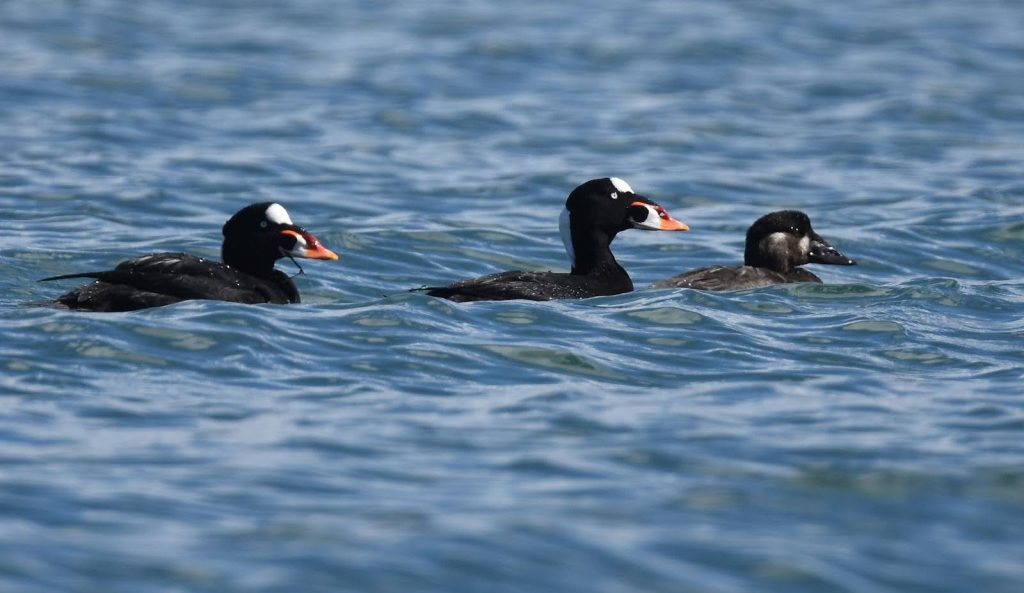
Surf Scoters, one of the 15 extant species of sea ducks.
This year’s new Student Fellowship Awardees are:
Caroline Blommel – University of Washington
Project Title: Harvest assessments for sustainable management of surf scoters wintering in Washington State
Proposal Summary: As part of her larger PhD dissertation, Caroline is proposing to develop a simulation-based analytical framework for evaluating the long-term impact of a range of harvest regulations on the Washington Surf Scoter population. She will then incorporate new estimates of abundance, harvest, and survival garnered from partners and other chapters of her dissertation to update the framework. These results will be valuable for decision making by waterfowl managers and are clearly linked to SDJV priorities.
Chandler Garcia – University of Texas El Paso
Project Title: Evolutionary history of extinct Labrador Duck using whole-genome approach
Proposal Summary: As part of his Ph.D. dissertation, Chandler will conduct a population-level nuclear genomic study of the Labrador Duck to test whether it represents a distinct evolutionary lineage within Tribe Mergini or if its genome reflects an ancient admixture event. He is testing the hypothesis that the Labrador Duck represents a small, remnant hybrid population which led to its extinction (or simply was a small hybrid population doomed from the start). The results will provide insight into historical gene flow and demographic processes shaped genomic and evolutionary patterns in Tribe Mergini (sea ducks).
Geneviève Gauthier – Université Sainte-Anne
Project Title: Survival, Breeding-site Fidelity and Breeding Dispersal in Red-breasted Mergansers: Evaluating Causes and Consequences Using Live Recapture and Dead Recovery Data
Proposal Summary: Geneviève’s Master’s project aims to estimate survival, breeding site fidelity and breeding dispersal in a colony of Red-breasted Mergansers in New Brunswick, using a combination of live recapture and dead recovery data gathered from 1992 – 2025. Genevieve will evaluate the roles of reproductive success, female age, body condition and conspecific brood parasitism on demographic rates. She also aims to determine effects of breeding dispersal on subsequent breeding phenology and success.
Steele Grasza – Queen’s University
Project Title: Genomic Health and Disease Resilience in Northern Common Eiders: Expanding Whole-Genome Analyses to Understand Avian Cholera Impacts
Project Summary: This Master’s project aims to quantify genomic health, including inbreeding, evolutionary constraint, and mutational load, of Common Eiders using whole-genome sequencing. Steele will compare metrics between birds that survived the 2006 Arctic Canada avian cholera outbreak, birds that died, and those post-outbreak to determine if disease-driven selection has taken place. This will establish genomic health indicators that could be used to evaluate population vulnerability of other populations. The results will clarify whether genomic health indicators can be incorporated into long-term monitoring and conservation strategies, and may help anticipate future eider population responses to diseases.
Mairin Murphy – Colorado State University
Project Title: Investigating Nesting and Predator Ecology of Sea Ducks on the Yukon-Kuskokwim Delta to Identify Mechanisms of Decline
Proposal Summary: Objectives of this Ph.D.project include determining factors contributing to Common Eider, Spectacled Eider, and Brant nest success on the Yukon-Kuskokwim Delta, Alaska, where breeding populations of eiders are declining. Mairin will evaluate the relative importance of predation by different predator species, incubation strategies, and changing predator diet on reproductive parameters of eiders. This project will focus on a high-priority species for the SDJV (Common Eider) in an important waterfowl production area under threat from rapid climate change.
The Sea Duck Joint Venture Student Fellowship Program was created in 2022 with the goal of increasing the number of skilled early career professionals interested in sea duck conservation. Students pursuing a M.S. or Ph.D. degree at a U.S. or Canadian university with a research focus on sea duck management, conservation, or science, are eligible to apply. Master’s students are eligible for one year of funding and Ph.D. students are eligible for two years of funding. In addition to this year’s awardees, the Student Fellowship Program has previously supported 13 students. We cannot wait to see what this year’s student fellows discover!