Every year, a large proportion of Pacific Common Eiders (Somateria mollissima) migrate from their Alaskan and Canadian breeding grounds to fall staging and wintering areas on the coast of Russia. Harvest rates across this region are poorly understood, making it challenging to model and manage Common Eider populations. The connectivity of North American and Russian habitats necessitates that organizations from the United States, Canada, and Russia work together to understand hunting pressures across the entire range of the Common Eider.
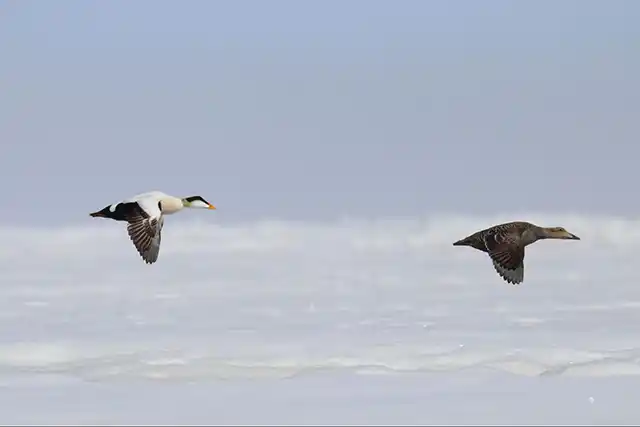
Pair of Common Eider in flight. Credit: Shiloh Schulte / USFWS
Prior Research on Hunting Trends and Common Eiders
Prior research has analyzed the impact of hunting, climate change, and habitat loss on Common Eider populations. Between 2001 and 2006, Russian researchers Dr. Konstantin Klokov (St. Petersburg State University) and Dr. Evgeny Syroechkovskiy (BirdsRussia) led surveys in the province of Chukotka focused on eider hunting and egg harvesting. In 2011, Dr. Martin Robards and colleagues at the Wildlife Conservation Society (WCS) convened an experts working group to analyze the vulnerability of Arctic birds to climate change and found Common Eiders at the top of the list. While climate-driven habitat loss is a key threat to eiders, the WCS team also wanted to build upon the earlier Russian surveys to understand how contemporary hunting impacts eider populations across their range.
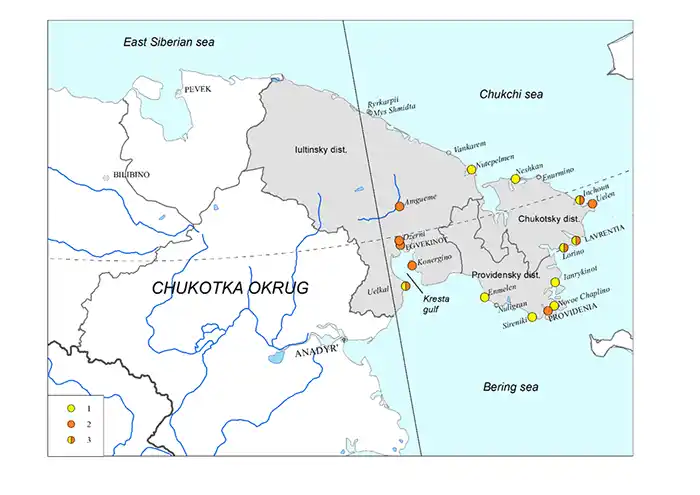 Map depicting surveyed settlements. “1” corresponds to settlements surveyed between 2001 – 2006. “2” corresponds to settlements surveyed in 2023. “3” corresponds to settlements that were surveyed both between 2001 – 2006 and in 2023. Credit: Eugenia Bragina / WCS
After 20 years, the Russian monitoring surveys that concluded in 2006 needed to be updated. Klokov and Syroechkovskiy teamed up with Robards and Dr. Eugenia Bragina (WCS) to develop a new round of hunting surveys in the same areas previously surveyed to understand how hunting pressure had changed over time. Syroechkovskiy had also recognized limitations in the statistical analysis of his original project. Consequently, the team brought in Dr. Liliana Naves (Alaska Department of Fish and Game, or ADF&G), who led hunting surveys for ADF&G’s Division of Subsistence and could bring that experience to the analysis of Russian hunting data.
Research Continued Through SDJV Project #164
This new project sought to develop a methodology and implementation plan for estimating harvest of Common Eiders in eastern Russia, including its magnitude, the distribution of hunting pressure, and observations of how hunting trends have changed over time. The project developed a survey tool for implementation by BirdsRussia. The Sea Duck Joint Venture, along with other partners, contributed funding to support this project.
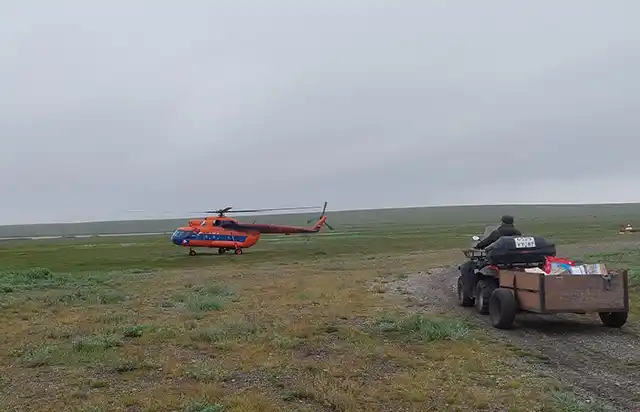
Helicopters and all-terrain vehicles were needed to access reindeer herders in the Russian tundra. Credit: Eugenia Bragina / WCS
The research team surveyed three districts in Chukotka – Chukotsky, Lultinsky and Providensky. As the project developed, they received additional funding to survey Spectacled Eiders (Somateria fischeri) and Steller’s Eiders (Polysticta stelleri) in areas of Bulunsky and Nizhnekolymski Districts in the neighboring province of Yakutia. Surveying remote communities is logistically challenging and people can be hesitant to share information. Thus, the development of a new hunting survey was a complex process. Specific changes included random sampling instead of targeting hunters only, surveying other commonly harvested species rather than just one species, examining egg harvesting, and including a variety of photos of each species.
Results of the 2023 Hunting Survey
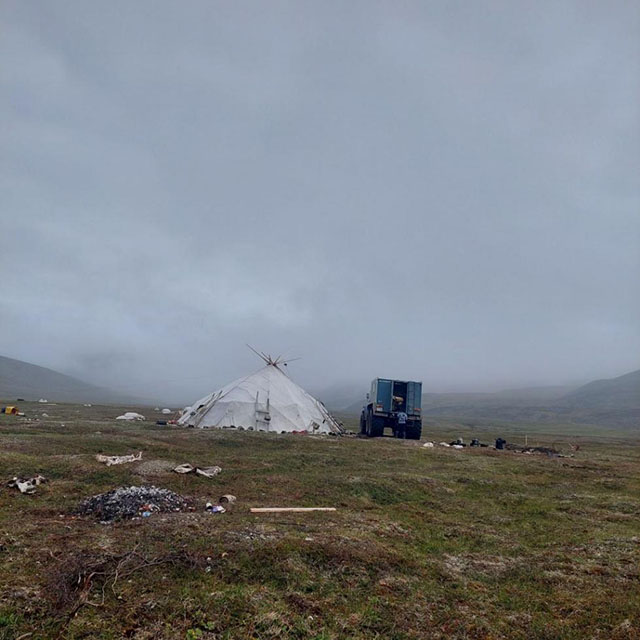
The “yaranga” is the traditional reindeer-hide tent of some nomadic Indigenous peoples in Russia, seen here next to an all-terrain vehicle. Credit: Eugenia Bragina / WCS
Overall, the research team found that, since the original survey, the number of bird hunters has declined dramatically and the average number of birds harvested per hunter, per species, has decreased. Aligned with this, they learned that the average harvest of Steller’s, Spectacled, and Common Eiders decreased multifold in the last two decades. In particular, although Common Eider is still one of the most popular species to harvest, recent harvest estimates are 5.5 times smaller compared with the 2000s. Harvest estimates for Long-Tailed Duck (Clangula hyemalis), Brant Goose (Branta bernicla), and Emperor Goose (Anser canagicus) also declined multifold. For example, for all three districts in Chukotka, about 1,000 Emperor Geese were harvested annually in Chukotka in the 2000s but only around 150 are harvested annually today. Harvest of Bean Goose (Anser fabalis), Lesser White-Fronted Goose (Anser erythropus), and Greater White-Fronted Goose (Anser albifrons) stayed the same or increased.

Uelen, one of the villages surveyed in Chukotka, Russia. Credit: Eugenia Bragina / WCS
Many hunters shared that they hunt less because local development has increased access to other food sources and because it is difficult for them to obtain all necessary hunting permits, weapons, ammunition, and other supplies. Often, obtaining the required licenses involves costly long-distance travel, which limits participation. Some hunters suggested reassessing hunting regulations for remote, Indigenous communities to reduce these burdens. Other hunters shared that they believe eiders are declining or have moved, and that goose populations are higher than before, causing them to shift towards hunting geese over eiders. However, the lack of past monitoring efforts may have also influenced the baseline data and results.
Collaboration at a Flyway Scale
This study offers a broader understanding of both hunting pressure and the significance of hunting to communities in Chukotka and Yakutia, Russia. This information can be used to improve conservation efforts, management practices, and endangered species regulations for American, Russian, and Canadian partners. It is directly relevant to the Arctic Council’s Arctic Migratory Bird Initiative as part of their interest in understanding hunting on the Circumpolar Flyway. Going forward, the research team hopes to expand their surveys geographically to understand how hunting pressures impact eider populations across their range.
Both Robards and Bragina emphasize the importance of collaboration at a flyway scale. Despite the challenges, working across borders to address shared conservation and harvest goals is critical for the survival of migratory species like eiders. Robards and Bragina hope that this project will prompt further research, or even a long-term monitoring program, between American, Canadian, and Russian partners.