Meet Mairin Murphy, a PhD student selected in 2026 for the Sea Duck Joint Venture Student Fellowship Award. This fellowship will support Mairin’s research on interactions between predators and ground-nesting waterfowl in the Yukon-Kuskokwim Delta – specifically Common Eiders (Somateria mollissima), Spectacled Eiders (Somateria fischeri), and Pacific Black Brant (Branta bernicla nigricans).
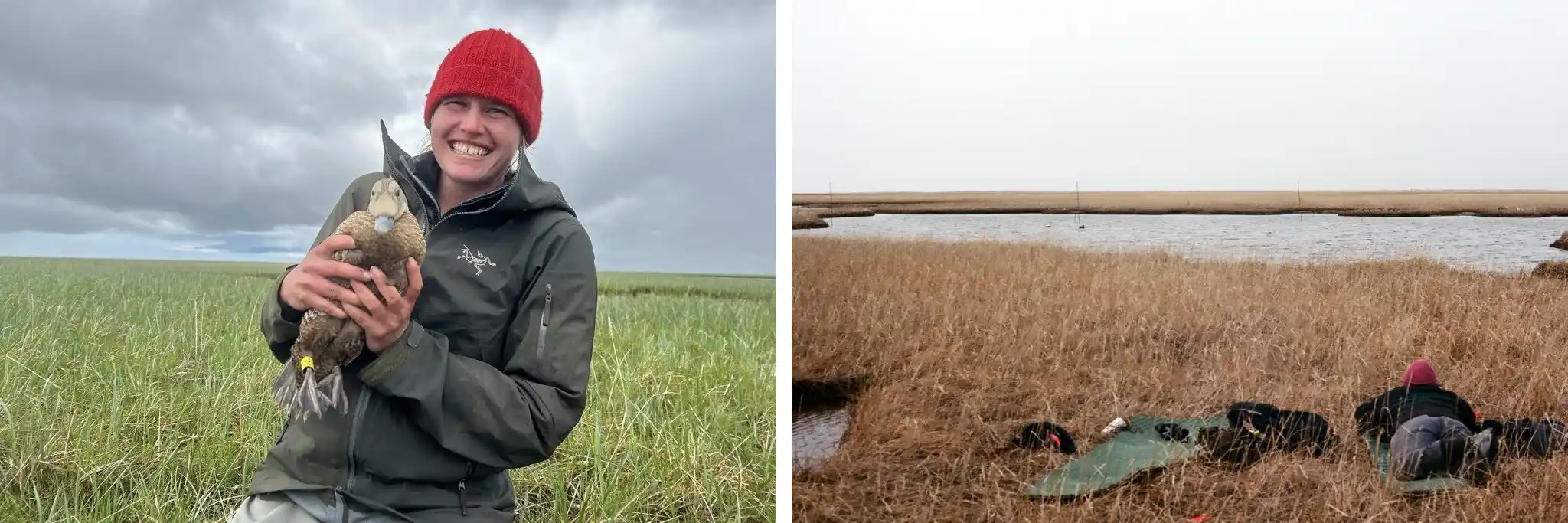
Left: Mairin holding a Spectacled Eider. Right: Lying in the grass waiting for eiders.
Mairin has been interested in birds since childhood. Growing up in Northern California close to the Pacific Ocean, she could always hear the waves from her house and grew up loving the sea. These combined passions inspired her to obtain an undergraduate degree in marine science and biology from the University of Miami, and eventually led her to sea duck research. She received her Master’s Degree from the University of Wisconsin–Stevens Point in wildlife biology and is now pursuing her PhD at Colorado State University.
2026 will be Mairin’s fourth summer conducting field work on the Yukon-Kuskokwim Delta. In prior summers, she collected data for her Master’s thesis while working for the U.S. Fish and Wildlife Service (USFWS), whereas this research will support her PhD dissertation. Her field camp will include her field technician, another PhD student who is studying Pacific Black Brant, and his three technicians. Beyond this small camp, however, Mairin will be in the midst of a vast, remote, and sparsely populated wilderness.
The Yukon-Kuskokwim Delta: Where the Tundra Meets the Sea
The Yukon-Kuskokwim Delta is located in western Alaska, just below the Arctic Circle. It includes the deltas of Alaska’s two largest rivers (the Yukon and the Kuskokwim), which flow into the Bering Sea. The region contains millions of square miles of coastlines, intertidal and freshwater wetlands, rivers and lakes, and alpine tundra. More information about this site is available in the Sea Duck Key Habitat Sites Atlas or accompanying story map.
Mairin compares walking through the tundra to “snorkeling on land.” The layers of deep mosses and crunchy lichens remind her of the complex structures of soft and hard corals. Like coral reefs, both wetlands and tundra have a unique array of biodiversity. According to USFWS, over one million ducks and half a million geese breed there annually. But breeding populations of both Common Eiders and Spectacled Eiders are decreasing, and nest success is declining for unknown reasons.
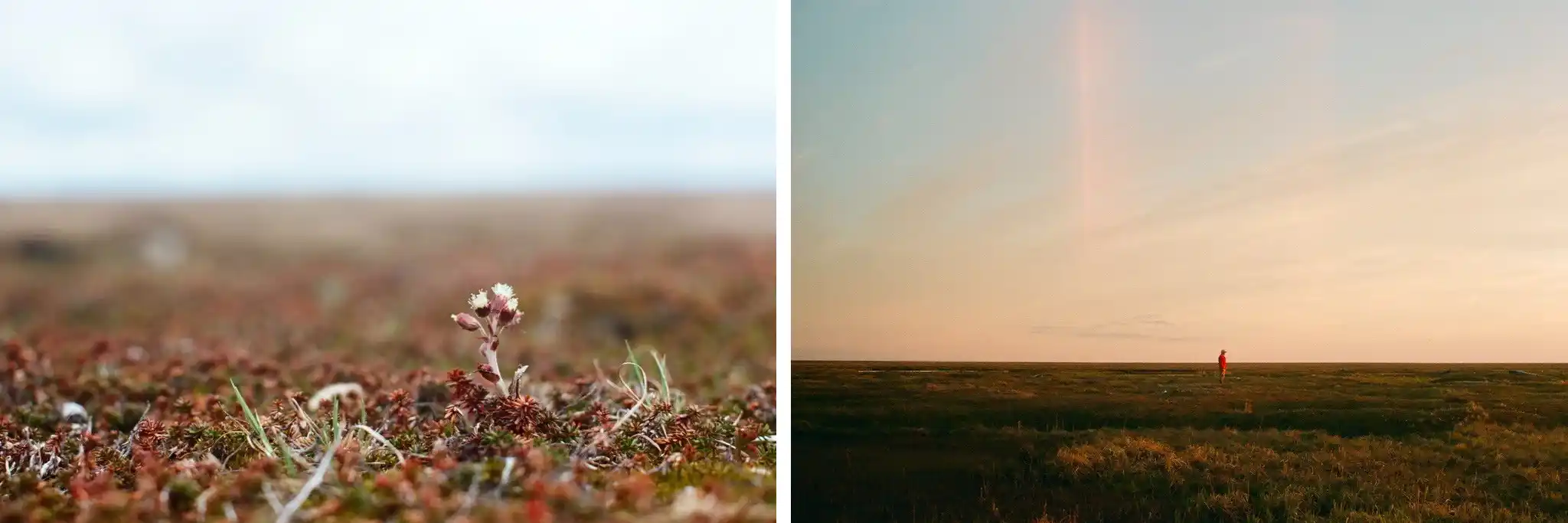
Left: Close-up view of the tundra. Right: USFWS Wildlife Biologist Dan Rizzolo during the summer solstice on the Yukon-Kuskokwim Delta.
Investigating Nesting and Predator Ecology to Identify Methods of Decline
Mairin’s research will determine factors that contribute to eider and brant nest success. One of her main objectives is to evaluate the relative importance of nest predation by foxes and gulls. Scientists suspect that nests are failing due to growing fox pressure, but there is little formal evidence to show that either fox populations are increasing or that they are eating more eggs. Mairin will directly survey nests using game cameras to determine what is preying upon them, and examine how eiders and brant respond to these two predator species. She will also analyze 25 years of fox fur and tissue samples. If foxes are eating more birds and fewer voles, their changing diets should produce different isotope signatures that would be evident in the samples.
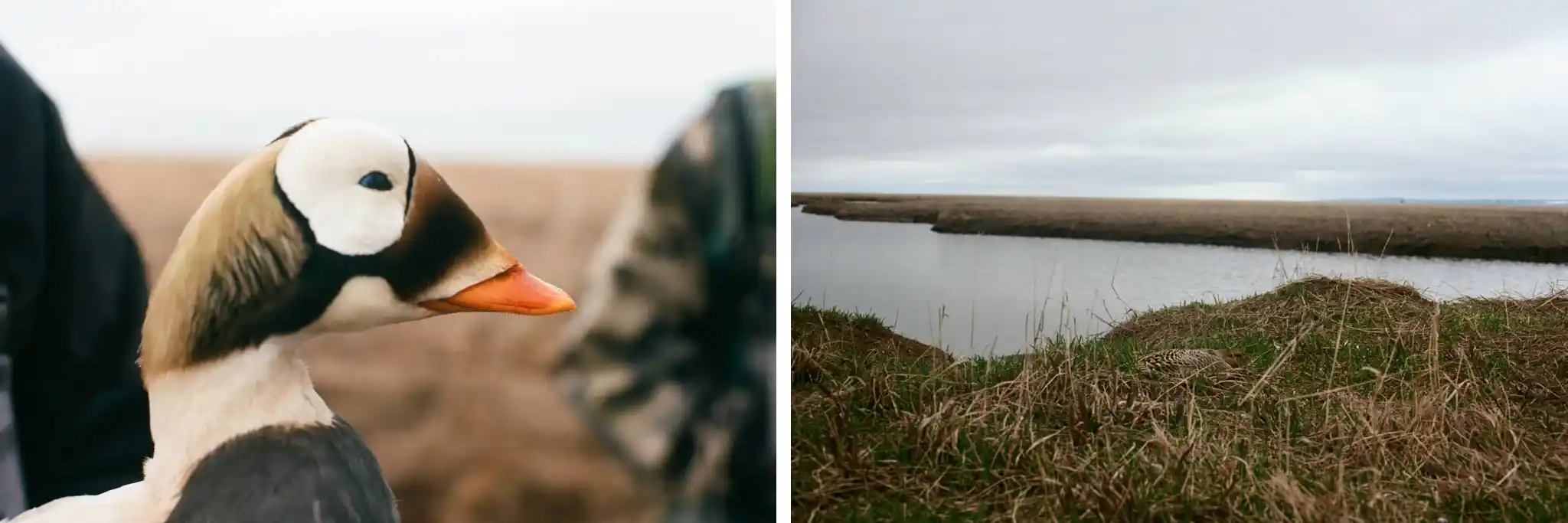
Left: Spectacled Eider. Right: Nesting Common Eider.
Mairin will also study how body condition impacts incubation and nest success, and how body condition is affected by sea ice. Sea ducks prefer a “Goldilocks Zone” for sea ice. If there is too much ice, sea ducks are unable to dive for prey species. However, if there is too little ice, they will not have surfaces to rest upon. Previous research shows that both negatively impact sea duck health and reproductive success. Mairin will gather blood samples from the birds as they fly in off the ice to land and observe how long they incubate their nests.
Working on Tundra Time
Mairin describes working on the Yukon-Kuskokwim Delta as a “logistical nightmare.” There are virtually no roads, so in early May a helicopter will drop off the field crew, their equipment, and a weeks-long supply of food and water. Their camp will be inaccessible for the first month of the field season, until the river ice breaks up and the crew can boat to nearby communities to restock supplies. In addition to canned and boxed goods, they pack in hardy produce like onions, potatoes, broccoli, and bell peppers. There is no cell service, no electricity, and neither fresh nor running water. After a while, Mairin sighs, everyone becomes “nose-blind” to their own smell.
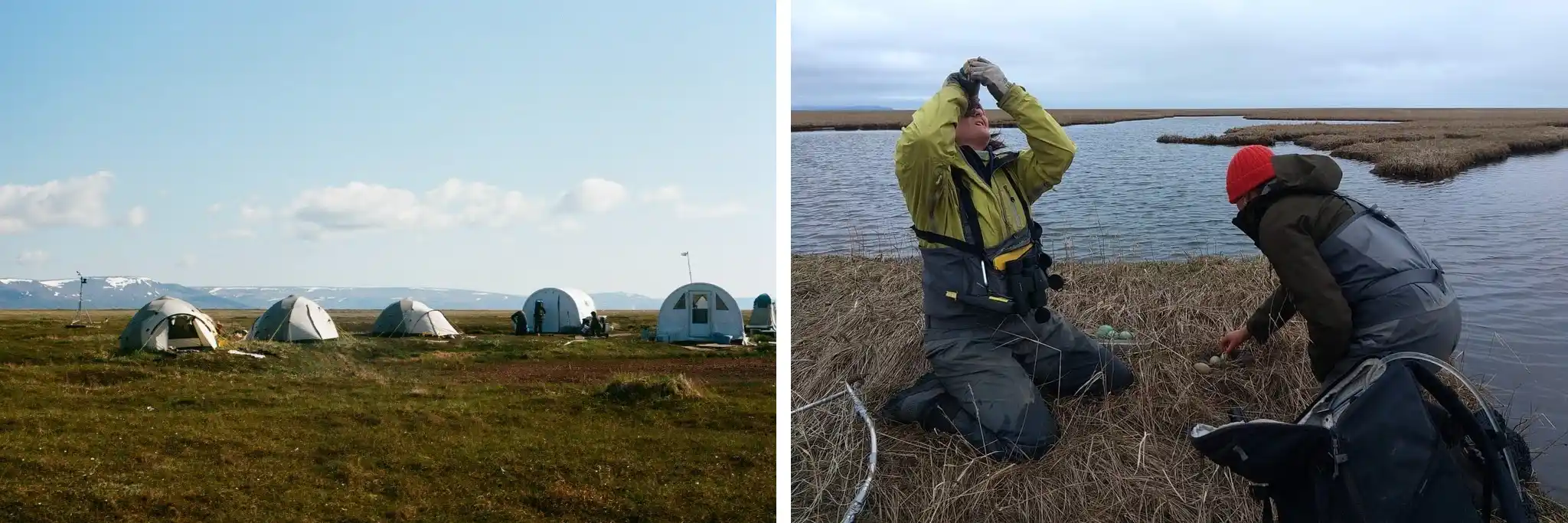
Left: USFWS field camp on the Yukon-Kuskokwim Delta. Right: Mairin conducting field work with USFWS Wildlife Biologist Ali McCarron.
The Yukon-Kuskokwim Delta is so far north that it never truly gets dark in the summer. Eventually, Mairin describes, internal clocks shift, and the field crew starts to work on “tundra time.” The field crew usually sleeps in until 9am or 10am, and begins the day with a breakfast feast of pancakes and bacon. Around 11am, everyone dons their waders and begins searching through the survey area for brant and eider nests. Often, researchers work until 11pm. The day ends with entering field data, cooking meals like burritos on the big camp stove, and playing cards or reading. Mairin says it can be challenging to fall asleep due to the constant daylight, which is accompanied by a cacophony of birdsong. Twilight does not begin until around 3am, at which point the birds fall silent, and the delta becomes so quiet that it wakes Mairin up.
Impact of Student Fellowship Research
The Sea Duck Joint Venture is excited to support Mairin’s project, which focuses on high-priority species in a critical waterfowl production area that is under threat from rapid climate change. Mairin’s research will not only benefit future policy on human-predator-prey interactions, but also help researchers understand how the Yukon-Kuskokwim Delta is changing. After completing her PhD, Mairin’s long-term goal is to advise conservation policy or to conduct research in a non-academic capacity.
You can learn about other recipients of the Student Fellowship Award here. We look forward to seeing their accomplishments and learning from their research!
All photos were taken and provided by Mairin Murphy.